

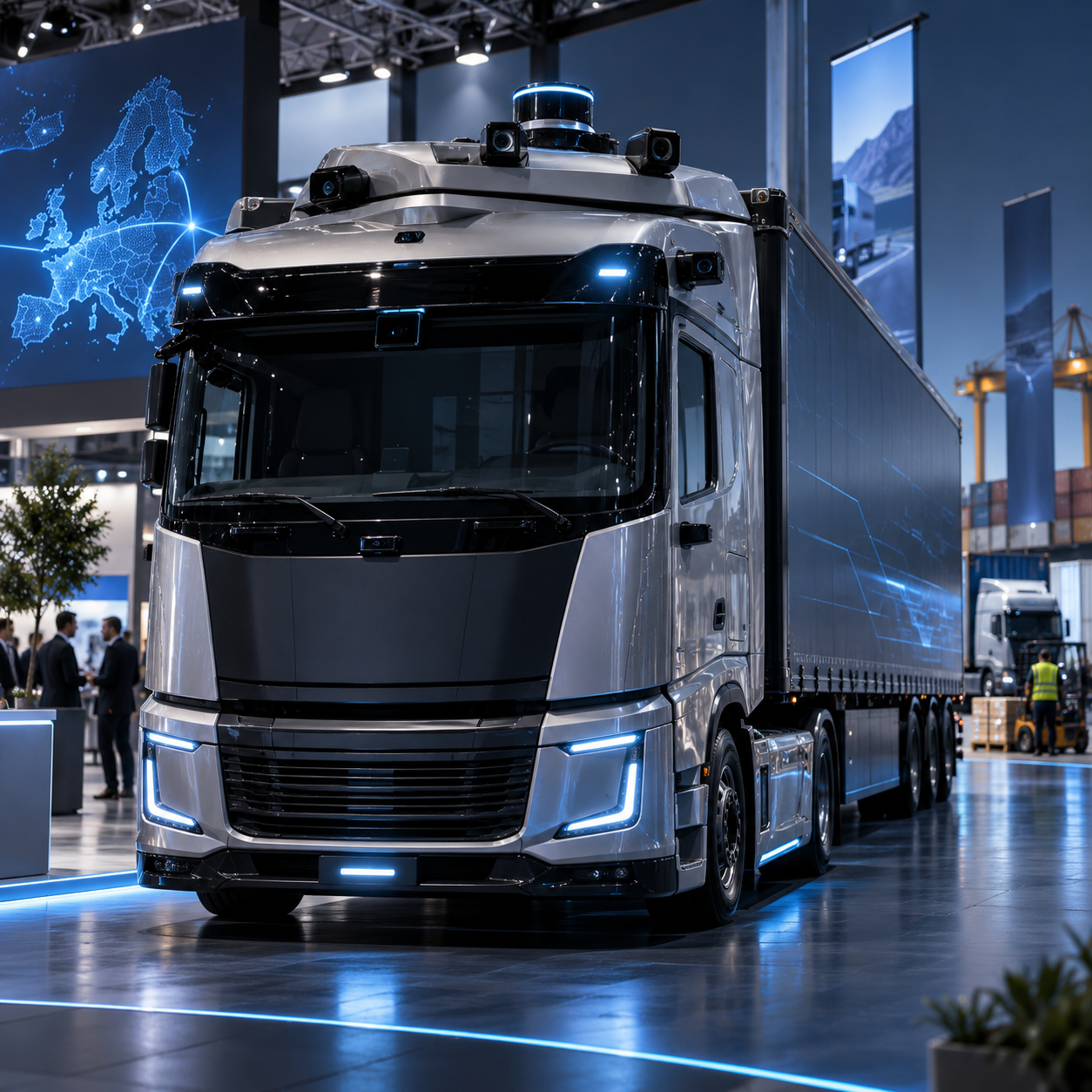
Pony.ai is taking its autonomous-driving ambitions beyond robotaxis.
The Chinese technology company has unveiled a new fourth-generation Level 4 autonomous heavy-duty truck developed together with GAC Commercial Vehicle, marking another step toward large-scale commercial deployment of self-driving freight vehicles, according to Pony.ai’s official announcement.
The new Robotruck made its global debut at IAA Transportation 2026 in Hannover, Germany.
That location was significant.
Pony.ai is not only preparing the vehicle for production in China. The company is also openly positioning Europe and the Middle East as future markets for its autonomous trucking business.
Volume production of the new model is scheduled to begin later in 2026.
Built on an electric heavy-duty platform
The new Robotruck is based on GAC Commercial Vehicle’s T9 battery-electric heavy-duty truck platform.
Pony.ai integrates its fourth-generation Level 4 autonomous trucking system with the vehicle’s drive-by-wire architecture.
The truck is designed for several commercial freight applications, including:
- long-haul transportation
- dedicated-route logistics
- port transportation
Level 4 autonomy means the vehicle can operate without human intervention inside defined operating conditions.
That does not mean the truck can drive autonomously everywhere under every possible condition.
The distinction matters.
Level 4 systems are designed around specific operational domains where the vehicle, infrastructure, maps, regulations and operating conditions have been validated.
Redundancy is central to the design
Autonomous heavy trucks require an unusually high level of safety engineering.
A passenger vehicle losing one system is serious.
A fully loaded heavy-duty truck losing control can have much greater consequences.
Pony.ai says the new Robotruck therefore uses fully redundant architectures across critical systems including:
- steering
- braking
- communications
- power supply
- computing
- sensing
The autonomous-driving kit includes nine lidars, three millimeter-wave radars and 13 cameras.
Together, those sensors are designed to provide 360-degree perception around the truck.
The system also uses the same domain controller architecture as Pony.ai’s seventh-generation Robotaxi platform.
That shared technology is strategically important because the company can reuse parts of its software, computing and autonomous-driving development across multiple vehicle categories.
Cost reduction may matter more than the hardware
Autonomous trucking will not succeed simply because the technology works.
It also has to make economic sense.
Pony.ai says the bill-of-materials cost of the autonomous-driving kit has been reduced by about 70% compared with the previous generation.
The company also expects transportation costs per ton-kilometer to fall by around 30%.
Those are company projections rather than independently verified operating results, but they illustrate the commercial target clearly.
The challenge is no longer only:
Can a truck drive itself?
The more important question is:
Can an autonomous truck move freight more cheaply, safely and consistently than existing alternatives?
Pony.ai also says its energy-efficiency software, combined with the aerodynamic design of GAC’s T9 platform, could reduce energy consumption by approximately 10% compared with conventional trucks.
Again, these figures should be treated as company targets until larger commercial deployments produce real-world operating data.
Europe is becoming part of the strategy
Pony.ai says it plans to expand its Robotruck business into Europe and the Middle East over the next two years.
Reuters reported that the company is already talking with European governments and ports about testing permissions.
Europe is an attractive market for autonomous freight technology for several reasons.
Truck-driver shortages remain a problem in parts of the region.
Labor costs are relatively high.
Ports, logistics hubs and fixed freight corridors also provide environments where autonomous systems can potentially be introduced gradually.
Those characteristics make trucking very different from fully autonomous passenger driving through unpredictable city streets.
A freight vehicle operating repeatedly between the same logistics centers can work inside a much more controlled operational domain.
That could make commercial autonomous trucking one of the earlier large-scale applications of Level 4 technology.
Pony.ai already has a European foothold
Pony.ai’s expansion into Europe is not starting with trucks.
The company has already been building partnerships around autonomous passenger vehicles.
In Croatia, Pony.ai and Verne recently began fully driverless Robotaxi test rides with invited passengers in Zagreb.
The test route connects Verne’s headquarters and a major business district with Zagreb Airport.
Pony.ai described the project as an important step toward future commercial driverless operations in Europe.
That existing European experience could prove useful as the company begins exploring autonomous freight deployments.
Robotaxis and Robotrucks are different markets, but they share key technologies involving perception, prediction, planning and safety validation.
Autonomous trucking may scale differently from robotaxis
Robotaxis receive enormous public attention because people immediately understand the idea of entering a vehicle with no driver.
Autonomous trucks may ultimately have an equally important economic impact.
Freight transportation operates continuously.
Trucks travel enormous distances.
Driver availability, fuel or electricity consumption, vehicle utilization and maintenance all affect logistics costs.
Even relatively small improvements can become significant when multiplied across large fleets.
Autonomous trucks may also be able to operate for longer periods without the same driving-hour limitations that apply to human drivers, although regulations, charging, maintenance and operational safety still impose practical constraints.
For logistics companies, the attraction is therefore not the novelty of having a truck without a driver.
It is increased utilization and lower operating cost.
China’s autonomous-driving companies are looking outward
The Pony.ai announcement also reflects a broader change in China’s technology sector.
Chinese electric-vehicle and autonomous-driving companies increasingly view Europe as an important international market.
At IAA Transportation, multiple Chinese commercial-vehicle manufacturers are competing for attention in electric and intelligent trucking.
That means European truck manufacturers may eventually face competition not only in battery-electric vehicles but also in autonomous-driving software and integrated logistics systems.
Pony.ai’s strategy combines both.
The company works with vehicle manufacturers rather than trying to build every part of the truck itself.
GAC supplies automotive engineering and manufacturing.
Pony.ai supplies the autonomous-driving system.
That partner-led approach could allow the technology to scale faster if regulators and customers accept it.
The difficult part comes next
An impressive technology launch is only the beginning.
Heavy-duty autonomous vehicles still face difficult questions.
Regulators have to approve their operation.
Insurance frameworks must evolve.
Companies need reliable remote support and fleet-management systems.
Autonomous vehicles also have to prove themselves across weather, road construction, sensor failures and countless unusual situations.
And the economics must work outside controlled pilots.
Europe’s regulatory environment could therefore become one of the biggest tests for Pony.ai’s international strategy.
Mass production is important.
Commercial deployment is harder.
RoviVox View
Pony.ai’s new Robotruck is interesting because autonomous trucking may reach meaningful commercial scale differently from robotaxis.
Trucks often operate on predictable routes between logistics centers, ports and industrial facilities.
That creates environments where Level 4 autonomy can potentially be introduced gradually and measured economically.
The 70% reduction Pony.ai claims for the cost of its autonomous-driving kit may therefore be one of the most important numbers in the announcement.
Autonomous technology only becomes transformative when companies can afford to deploy it at scale.
Europe will now be an important test.
If Pony.ai can move from demonstrations and controlled pilots into real freight operations, its Robotruck expansion could become one of the clearest examples of Chinese autonomous-driving technology entering the European industrial market.
For RoviVox, the story is therefore about more than another self-driving truck.
It is about the next phase of autonomous transport moving from technology development toward international competition.