

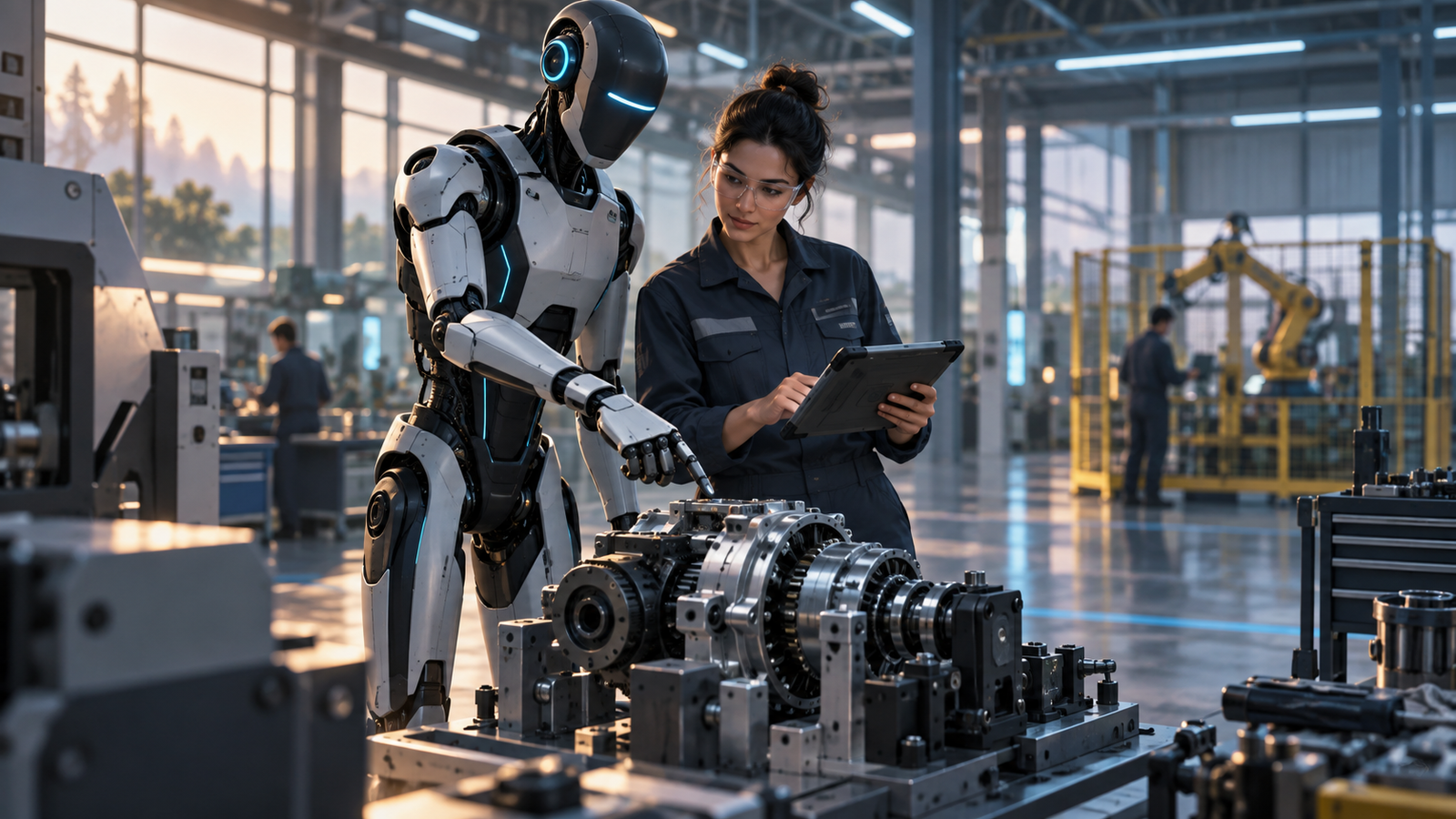
Agility Robotics has spent years trying to answer one of the most important questions in humanoid automation:
What happens when robots leave isolated work cells and begin sharing the same floor with people?
Its latest answer is Digit 5.
Unveiled on September 15, the fifth generation of Agility’s humanoid robot is designed around what the company calls “cooperative safety” — the ability to operate in industrial environments in close proximity to human workers without relying on the traditional physical barriers used around many forms of automation.
That could prove far more important than another humanoid learning to run, jump or perform a carefully choreographed demonstration.
For humanoid robots to scale inside factories and warehouses, they have to become useful around people.
Safety may be the real scaling problem
Traditional industrial automation is often separated from workers by fences, cages, scanners or dedicated safety zones.
That model works extremely well for fixed robots performing repetitive operations.
Humanoids are supposed to offer something different.
Their main advantage is flexibility.
A humanoid can potentially move between workstations, use infrastructure designed for people and perform tasks in areas where installing permanent automation would be difficult or expensive.
But that flexibility loses much of its value if the robot still needs a large protected zone around it.
Digit 5 is being developed specifically around that problem.
Agility says its proprietary human-detection system and functional safety behaviors are designed to allow the robot to respond when a person enters its operating space.
The goal is to reduce the need for external physical barriers.
An important qualification remains: Agility also states that certain safety features are still in development and that safety systems cannot eliminate every operational risk.
Digit 5 is therefore an important step toward shared human-robot workspaces, not proof that the challenge has already been completely solved.
Built from real deployment experience
Agility says Digit 5 is based on lessons gathered from more than 65,000 hours of real-world operation.
That is significant because many humanoid platforms are still largely evaluated through prototypes and demonstrations.
Agility’s earlier Digit systems have already been used in industrial and logistics environments, part of a broader move toward humanoid factory logistics that RoviVox has also tracked.
According to the company, three years of customer feedback influenced the new generation.
That experience appears throughout the design.
Digit 5 is stronger, reaches higher, charges faster and supports interchangeable tools.
The robot stands approximately 1.81 meters tall and weighs about 129 kilograms.
Its maximum reach is approximately 2.2 meters, allowing it to interact with shelves and equipment designed for human workers.
Agility lists a payload of about 22.7 kilograms — 50 pounds.
That represents a roughly 40% increase compared with the previous generation.
A nine-minute charge changes the operating equation
Battery life remains one of the most practical limitations in mobile robotics.
A humanoid that performs useful work but spends too much time charging may struggle to justify its cost.
Agility says Digit 5 uses a new battery system offering around 90 minutes of operation followed by approximately nine minutes of charging.
That creates a targeted 10-to-1 run-to-charge ratio.
The company says this could allow more than 20 hours of productive work during a 24-hour period.
Again, these are manufacturer specifications for a pre-production platform and will ultimately need to be validated across large-scale customer deployments.
But the direction is important.
The commercial humanoid race is increasingly about uptime.
The winner may not be the robot that performs the most impressive demonstration.
It may be the one that can reliably finish the most work per day.
One robot, different hands
Digit 5 also introduces swappable end-effectors.
Instead of permanently giving the robot one style of gripper, Agility is using standardized mounting interfaces so different tools can be attached for different jobs.
That could allow the same humanoid platform to perform multiple workflows.
A robot might handle containers in one environment and use a different tool for machine tending or another industrial process.
That approach reflects a wider shift in humanoid robotics.
Companies increasingly want the robot body to become a general platform while software and interchangeable tools determine the actual job.
More than $300 million in orders
Agility says market interest has already resulted in more than $300 million in multi-year orders.
The company is targeting manufacturing, warehousing and logistics customers.
That figure should be understood as an Agility Robotics company statement rather than proof that Digit 5 has already generated that amount in completed revenue.
Still, it suggests commercial customers are willing to make significant commitments while humanoid technology is still developing.
Digit 5 is expected to enter early access during the first half of 2027.
Agility says broader availability for manufacturing, warehouse and distribution operators is planned by the end of 2027.
For the first time, the company also intends to expand commercial availability beyond North America into the European Union and United Kingdom.
Why Europe matters
European deployment will present a different challenge from selling robots in the United States.
Industrial machinery operating near people must satisfy strict safety and conformity requirements.
Agility says Digit 5 is expected to carry CE marking and other regulatory certifications required for access to European and UK markets.
Successfully moving a humanoid from controlled deployment into regulated commercial environments would represent a meaningful milestone.
The industry has produced plenty of impressive robots.
The next phase is about proving they can become ordinary industrial equipment.
From robot demonstrations to robot coworkers
Humanoid robotics has changed rapidly during the past several years.
Early attention focused heavily on locomotion.
Could a robot walk reliably?
Could it climb stairs?
Could it recover after losing balance?
Those problems still matter.
But industrial customers care about a different set of metrics:
How many hours does it work?
How often does it fail?
How quickly can it learn another task?
How safely can people work around it?
How much does each completed task cost?
Digit 5 is clearly designed around those questions.
That may be a sign that the humanoid sector itself is maturing, alongside efforts to define common capability frameworks for physical AI robots.
RoviVox View
The most important feature of Digit 5 may not be its increased payload or its faster charging.
It is the attempt to remove the invisible wall between humans and robots.
Humanoids only become truly flexible industrial machines if they can safely share the environments where people already work.
That is much harder than simply teaching a robot to walk.
It requires perception, functional safety, predictable behavior and years of operational validation.
Agility has an advantage because Digit already has real-world industrial experience behind it.
But Digit 5 still has to prove that the cooperative-safety concept works reliably at scale.
If it does, the humanoid industry could enter a very different phase.
Instead of asking whether robots can work inside factories, the question may become:
How closely can they work beside us?