

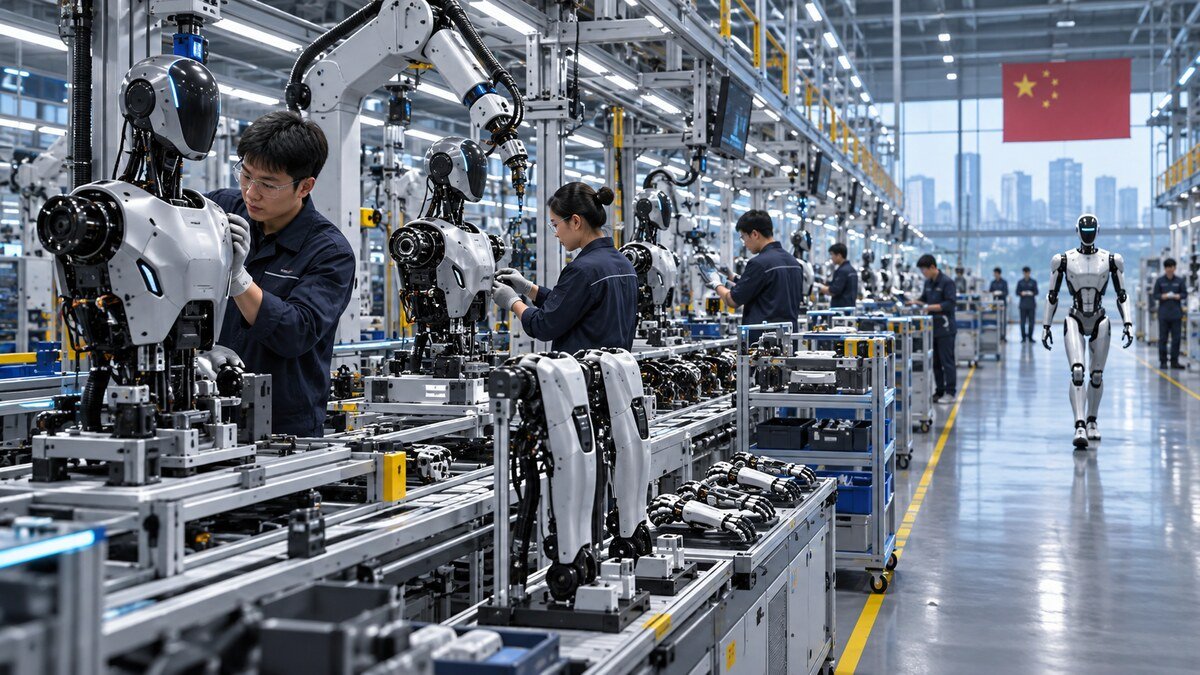
The humanoid robot race is beginning to look less like a research competition and more like a manufacturing industry.
In Liuzhou, southern China, UBTECH has opened a new smart manufacturing facility designed to produce humanoid and embodied-intelligence robots at a scale that would have seemed unrealistic only a few years ago.
The 14,000-square-meter facility began operation in September.
Chinese reporting says the factory is designed for annual production capacity of more than 10,000 units, with a stated line cadence of one completed robot roughly every ten minutes.
Those figures describe designed manufacturing capacity.
They should not be confused with proof that UBTECH is already shipping 10,000 humanoids a year.
That distinction is crucial.
But even as a capacity target, the factory demonstrates how quickly China is building the infrastructure required for a high-volume humanoid market.
Robots helping build robots
One of the most striking features of the Liuzhou plant is that robotic systems participate in the manufacturing process itself.
Reporting on the facility describes UBTECH robots, collaborative robot arms, automated guided vehicles and other automated systems handling tasks such as material movement, loading and production support.
The concept is easy to describe as “robots building robots.”
In practice, human workers, conventional industrial automation and newer embodied robotic systems are all part of the same production environment.
That hybrid model may be more realistic than the idea of a fully autonomous factory.
Humanoid robots do not need to replace every person in the building to change manufacturing economics.
They only need to become useful in jobs that conventional automation struggles to perform flexibly.
Why a 10-minute cadence matters
Manufacturing scale is about repeatability.
A company may be able to build a few hundred robots through highly skilled manual assembly.
Producing thousands requires a different system.
Components need predictable tolerances.
Software installation has to be standardized.
Quality control has to detect failures early.
Parts must arrive at the right station at the right time.
Every finished machine needs traceability.
A ten-minute production cadence therefore says more about the manufacturing system than it does about any one humanoid.
It suggests UBTECH is trying to move robotics toward the type of standardized production associated with mature industrial products.
Walker S2 is built around uptime
UBTECH’s Walker S2 provides a good example of how commercial humanoid design is changing.
The company positions the robot for industrial environments rather than entertainment demonstrations.
One of its most unusual features is autonomous battery swapping.
UBTECH says Walker S2 can replace a battery by itself in around three minutes.
That allows the robot to choose between charging and battery replacement depending on workload.
The goal is straightforward:
less downtime.
In a factory, an impressive robot that spends too much time charging may be less valuable than a simpler machine that works reliably for longer periods.
UBTECH already has commercial deployments
UBTECH says it delivered and recognized revenue from more than 1,000 full-size embodied-intelligence humanoid industrial robots during 2025.
The company says more than 80% of those sales were associated with industrial applications including automotive manufacturing, logistics, electronics, semiconductor production and other sectors.
Those are company-reported figures, but they demonstrate that UBTECH is already trying to build a commercial business rather than relying only on prototypes.
The company has also announced industrial projects with partners including Hitachi and multiple automotive manufacturers.
Capacity is not demand
A factory designed to produce more than 10,000 robots per year creates another question:
Who will buy them?
This may become one of the defining issues for the humanoid sector.
Manufacturing capacity is expanding rapidly in China.
But demand depends on whether customers can find tasks where humanoids generate measurable economic value.
A robot must be:
- reliable enough
- productive enough
- safe enough
- easy enough to deploy
- inexpensive enough
to compete with human labor or other forms of automation.
A large factory does not solve those problems automatically.
It simply creates the ability to manufacture quickly once the market is ready.
China’s supply-chain advantage
China’s robotics ecosystem extends well beyond complete robot manufacturers.
It includes actuator suppliers, motors, batteries, sensors, electronics, machining, AI systems and factory infrastructure.
That depth can shorten development cycles and reduce component costs.
The same industrial ecosystem that helped China scale electric vehicles could become an important advantage in humanoid robotics.
As production increases, manufacturers can place larger component orders.
Suppliers can invest in dedicated production.
Costs can fall.
Lower costs can create additional demand.
That feedback loop is one reason the manufacturing side of humanoid robotics matters as much as the software.
RoviVox View
The Liuzhou factory is important, but the headline number should be interpreted carefully.
Designed capacity of more than 10,000 robots is not the same as 10,000 customer deliveries.
The real milestone will come when factories like this can operate at high utilization because enough customers are ordering robots for productive work.
Still, the direction is clear.
Humanoid robotics is developing an industrial base.
The conversation is moving from “Can this robot be built?” toward “How quickly can we build thousands of them?”
The next question is the one that will decide the market:
Will there be enough useful work waiting for those robots when they leave the factory?