

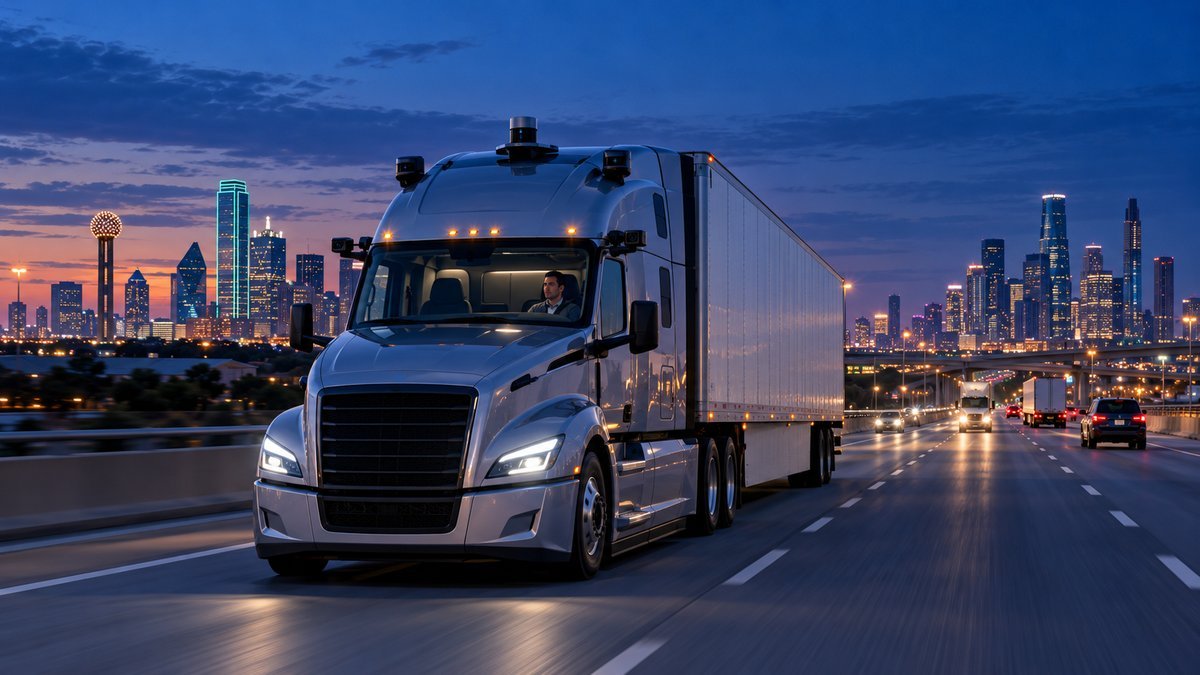
Autonomous trucking may be approaching one of its most important commercial tests yet.
Kodiak AI says it plans to launch unsupervised long-haul driverless service between the Dallas–Fort Worth area and Houston by the end of 2026.
The route follows Interstate 45 and spans roughly 219 miles between two of Texas’ largest freight markets.
Kodiak is already conducting daily preparation runs on the corridor.
According to the company, its current end-to-end deliveries between its Lancaster, Texas, hub and the Houston launch destination are being completed without intervention from the onboard safety observer — including on surface streets.
That is not the same as fully unsupervised public-road operation.
A safety observer is still present during these preparation runs.
Kodiak’s goal is to remove that person once its safety case is complete.
Dallas–Houston is the first long-haul launch lane
Kodiak has selected the Dallas–Houston corridor as its first unsupervised long-haul route.
That choice makes commercial sense.
Texas has major logistics centers, heavy truck traffic and a regulatory environment that has attracted autonomous-driving companies.
The Dallas–Fort Worth and Houston regions are connected by one of the country’s densest freight corridors.
A repeated route between known logistics hubs also gives an autonomous system a more defined operating environment than general-purpose driving across the entire road network.
That makes long-haul freight a particularly interesting target for Level 4-style autonomy.
What “intervention-free” means today
Kodiak says its launch platform now consistently completes end-to-end deliveries without the safety observer touching the wheel.
That is an important milestone, but it requires careful wording.
The truck is not yet operating unsupervised on the Dallas–Houston public-road route.
The current program is part of the final validation process.
Kodiak is conducting daily road runs with a safety observer as well as driverless validation work at closed-course test tracks.
The company says it intends to begin driver-out operations after completing its safety case.
The safety case is now central
As of the end of August, Kodiak said its Autonomy Readiness Measure for the long-haul domain had reached 93%.
The company defines that measure as the percentage of claims and supporting evidence in its safety case that are materially complete.
Kodiak expects to reach 100% before launching unsupervised highway operations.
The concept of a safety case is important because autonomous trucking cannot be evaluated using only miles driven or impressive demonstrations.
A company has to make a structured argument that the autonomous-driving system can operate safely inside a defined environment.
That includes evidence around perception, braking, system redundancy, failure handling, operational procedures and many other areas.
Kodiak already has driverless experience
The Dallas–Houston project is not Kodiak’s first experience operating without a human in the cab.
The company says it has nearly two years of driverless operations for a paying customer in the Permian Basin.
That work takes place in a different operating domain from long-haul highway freight.
But it gives Kodiak experience with real commercial driverless operations rather than purely experimental testing.
The company is now trying to transfer its autonomy system toward broader highway use. RoviVox has also covered Pony.ai’s separate Level 4 Robotruck plans for Europe.
Why trucking may commercialize faster than robotaxis
Fully autonomous passenger transport has to deal with a huge variety of urban situations.
Pedestrians, cyclists, school zones, complex intersections and unpredictable local traffic all increase difficulty.
Long-haul trucking has its own challenges, but much of the driving happens on highways.
That can reduce the number of interaction types an autonomous system needs to manage.
The economics are also compelling.
Trucks generate value when they move freight.
If autonomy allows vehicles to operate for longer periods, improves utilization or reduces dependence on driver availability, logistics companies may have a direct financial reason to adopt the technology.
That does not mean the transition will be simple.
Maintenance, regulations, insurance, remote assistance and terminal operations all have to work together.
But freight offers a clearer business case than many consumer autonomous-driving applications.
The next milestone is removing the observer
The industry has seen many autonomous-driving demonstrations where a human driver never touched the controls.
The more important threshold is when the vehicle operates with nobody in the cab.
Kodiak’s year-end target therefore matters.
If the company completes its safety case and starts regular unsupervised Dallas–Houston freight service, the project will move from preparation to true driver-out long-haul operation.
That is the point where the economics and reliability can begin to be tested at a new level.
RoviVox View
Autonomous trucking is becoming less about proving that software can control a truck and more about proving that an entire logistics system can operate without an onboard driver.
Kodiak’s Dallas–Houston plan captures that transition.
The current intervention-free runs are encouraging, but they are still part of the validation phase.
The decisive moment will come when the safety observer leaves the cab.
If Kodiak reaches that milestone on schedule, 2026 could become an important year in the shift from autonomous-truck pilots to regular driverless freight service.