

For most of the artificial-intelligence boom, the industry’s biggest constraints seemed obvious.
More GPUs.
More advanced chips.
More data.
More computing power.
But as AI systems become larger and data centers multiply, another constraint is becoming increasingly difficult to ignore:
electricity.
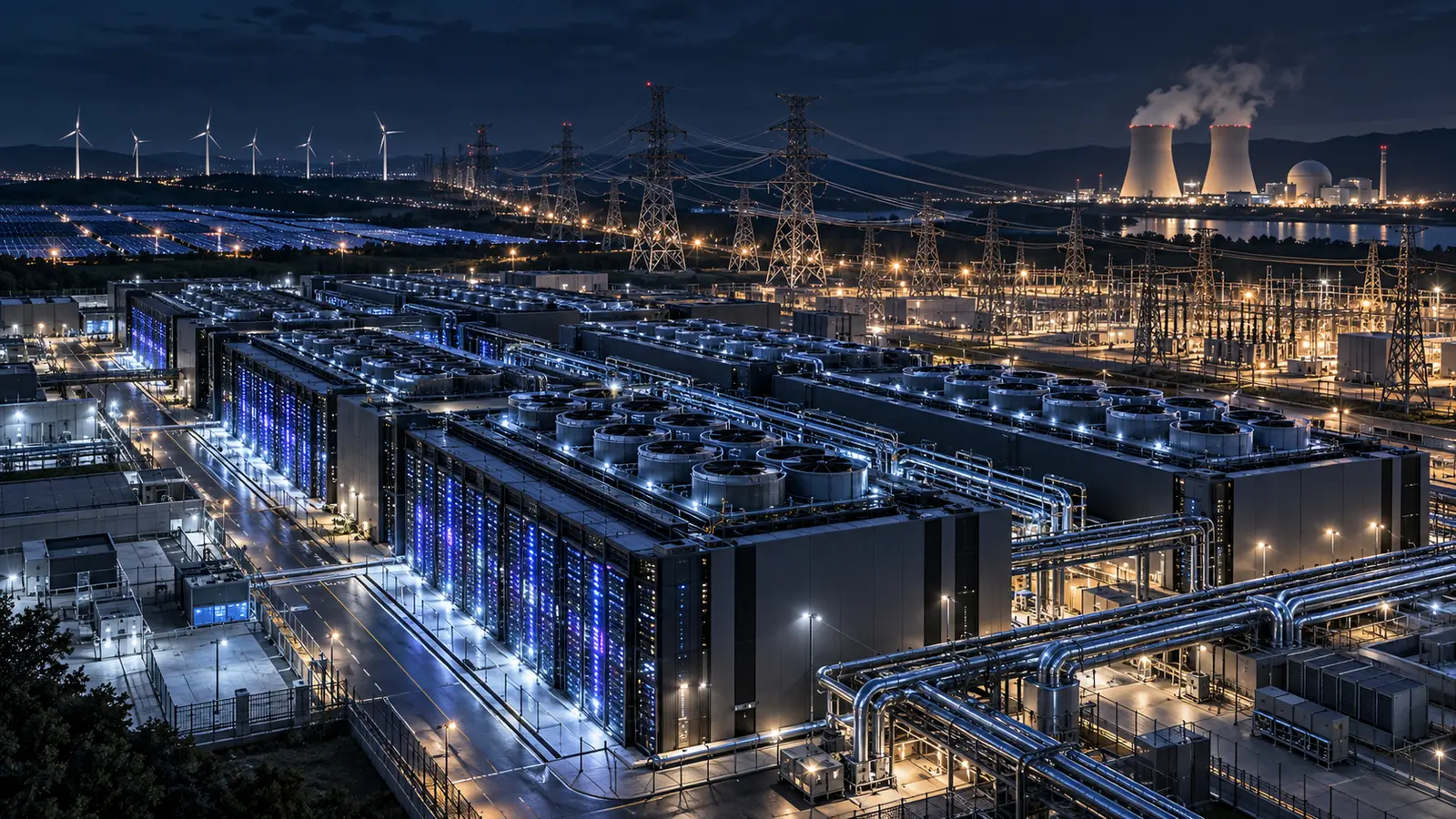
The next phase of the AI race may depend as much on power plants, transmission lines and electrical grids as it does on algorithms and processors.
That shift is already visible in the United States, where some of the world’s largest technology companies have committed to financing much of the new energy infrastructure required by their expanding data centers.
Big Tech is being asked to bring its own power
In March 2026, Amazon, Google, Meta, Microsoft, OpenAI, Oracle and xAI signed the U.S. Ratepayer Protection Pledge.
Under the voluntary commitment, companies agreed to build, bring or buy the additional electricity generation needed to support new data-center demand.
They also agreed to cover new power-delivery infrastructure upgrades associated with those facilities, according to the White House fact sheet.
The principle is straightforward:
If an AI company creates a major new electricity load, ordinary households should not automatically be expected to finance the infrastructure required to serve it.
That represents an important change in how the AI boom is being discussed.
The question is no longer simply:
How much computing power can companies build?
It is increasingly:
Where will the electricity come from?
AI is pushing electricity demand higher
The growth of AI infrastructure is arriving at a time when U.S. electricity demand is already expected to reach record levels.
According to U.S. Energy Information Administration figures reported by Reuters, U.S. electricity consumption is projected to rise from approximately:
4,195 billion kilowatt-hours in 2025
to:
4,270 billion kilowatt-hours in 2026
and:
4,349 billion kilowatt-hours in 2027.
AI-intensive data centers are one of the important drivers of that growth.
The numbers matter because electricity systems cannot expand as quickly as software.
A new AI model can be released in months.
A new high-voltage transmission line, power plant or major grid upgrade can take years.
That creates a fundamental mismatch between the speed of AI development and the speed of physical infrastructure.
Chips are only useful if they can be powered
NVIDIA and other semiconductor companies have spent years increasing the amount of computation available to AI developers.
But accelerators require enormous amounts of electricity.
So do the cooling systems, networking equipment, storage systems and other infrastructure surrounding them.
At large scale, an AI data center is not simply a computing project.
It becomes an energy project.
That means future AI expansion increasingly depends on factors that have little to do with model architecture.
Power availability.
Grid connections.
Permitting.
Transmission.
Energy prices.
Reliable backup generation.
Those variables may determine where the next generation of AI infrastructure gets built.
Nuclear power is becoming part of the AI conversation
One sign of the shift is the renewed attention being paid to nuclear energy.
Reuters reported in October that the U.S. government plans to provide approximately $4.2 billion in financing to Vistra to increase output from existing nuclear facilities.
The proposed upgrades would increase electricity generation without requiring entirely new nuclear plants.
AI data centers are not the only reason electricity demand is growing.
Electric vehicles, industrial electrification, cryptocurrency mining and other sources also contribute.
But rapidly expanding data-center demand is now a major part of the discussion around future electricity supply.
Large technology companies have also been pursuing their own nuclear-energy agreements and exploring other sources of reliable 24-hour power.
The attraction is clear.
AI infrastructure does not stop consuming electricity when the sun sets or the wind slows.
The grid may become the real bottleneck
Building electricity generation is only part of the problem.
Power has to reach the data center.
That requires transmission and distribution infrastructure.
In some regions, companies can build a data center faster than utilities can provide the electrical connection it requires.
Projects can therefore face long waits for grid access.
For AI companies, this creates a new competitive advantage.
The companies able to secure reliable power early may be able to deploy computing infrastructure faster than competitors.
That means energy procurement is gradually becoming part of AI strategy.
Who should pay for the expansion?
The economic question is becoming politically important as well.
On September 30, the U.S. Senate blocked the Ratepayer Protection Act, legislation that would have required regulators to examine whether large new electricity users such as data centers should bear more of the incremental infrastructure costs they create.
The debate is not simply about whether data centers should exist.
It is about how the cost of serving them should be distributed.
Technology companies want rapid access to enormous quantities of electricity.
Utilities need money to expand the system.
Households do not want their electricity bills to rise because a hyperscale data center arrived nearby.
Balancing those interests will become increasingly important as AI infrastructure expands.
AI companies are becoming infrastructure companies
The biggest AI companies increasingly resemble more than software businesses.
They are financing:
- data centers
- custom chips
- networking infrastructure
- power generation
- cooling systems
- transmission capacity
That represents an extraordinary change.
The companies building frontier AI systems may eventually need to control or secure large portions of the physical infrastructure underneath those systems.
OpenAI, Google, Microsoft, Meta and xAI therefore are not competing only over better AI models.
They are also competing for:
computing capacity.
land.
energy.
grid connections.
and capital.
Scale creates an advantage for the largest players
The enormous infrastructure requirements of frontier AI may also change the competitive landscape.
Training and operating advanced models already requires billions of dollars.
If companies must also secure their own electricity generation and grid infrastructure, the cost of competing at the frontier becomes even larger.
That could favor companies with:
- large balance sheets
- cloud infrastructure
- long-term energy contracts
- existing data-center networks
- relationships with utilities
Smaller AI companies may still innovate quickly.
But operating at the very largest scale could become increasingly difficult without access to enormous amounts of capital and energy.
The AI race is becoming physical
AI is often described as software.
But frontier AI depends on an enormous physical system.
Semiconductor factories produce the chips.
Data centers contain the machines.
Cooling systems remove the heat.
Electric grids deliver the energy.
Power plants generate it.
Transmission systems move it.
The more AI scales, the more visible that physical infrastructure becomes.
The next major breakthrough in artificial intelligence may still come from a better algorithm.
But deploying that breakthrough to hundreds of millions of users requires something much more traditional:
electricity.
RoviVox View
For years, the AI race was measured in models, GPUs and parameters.
The next phase may increasingly be measured in megawatts.
Chips remain critical.
But advanced processors are useful only when there is enough electricity to run them.
That is why energy generation, transmission capacity and grid access are becoming part of the AI technology stack itself.
The companies that dominate the next phase of artificial intelligence may not simply be those with the smartest models.
They may also be the ones capable of securing the enormous physical infrastructure required to keep those models running.
AI’s next bottleneck may not be intelligence.
It may be power.