

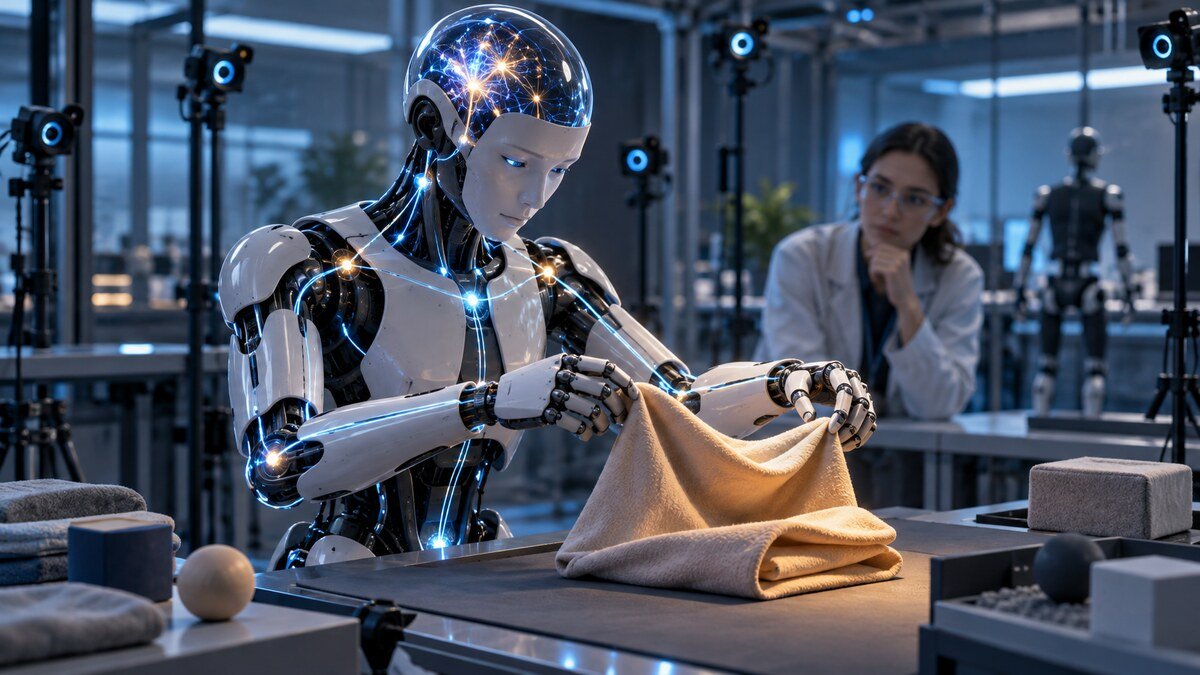
Humanoid robots are improving quickly.
They can walk faster, carry heavier loads, recharge more efficiently and perform increasingly complex manipulation tasks.
But one problem continues to define the entire industry:
The body is improving faster than the brain.
Chinese robotics startup Spirit AI believes that could begin to change soon.
In an interview with Reuters, co-founder Gao Yang said the company sees the possibility of a major breakthrough in embodied artificial intelligence by around the middle of 2027.
The comparison being discussed is ambitious: a “ChatGPT moment” for robots.
It does not mean humanoids are expected to suddenly become generally intelligent machines next year.
The idea is that robot software could reach an inflection point where machines become substantially better at understanding instructions and applying learned behavior to physical tasks.
Why robots need a different kind of AI
Large language models operate primarily in digital environments.
They process information and generate outputs without having to physically touch the world.
Robots face a harder problem.
A humanoid may understand the instruction “pick up that bag and place it in the container,” but completing the task requires many additional abilities.
The robot has to:
- recognize the bag
- estimate its position and shape
- approach without colliding
- choose an appropriate grip
- apply the right amount of force
- maintain balance
- move the object
- recover if the bag slips
A small error in any one of those steps can cause the whole task to fail.
That is why embodied AI has become one of the most important research areas in robotics.
Spirit AI is betting heavily on real-world data
Reuters reported that Spirit AI is using large amounts of real-world training data rather than depending primarily on simulation.
The company works with roughly 1,000 contractors who help produce physical-task demonstrations for robot learning.
That approach is expensive and time-consuming.
But physical data can capture details that are difficult to simulate perfectly, particularly when robots interact with flexible or unpredictable objects.
Spirit AI says its systems now reach roughly a 90% success rate on relatively simple tasks in structured environments.
That is meaningful progress.
It is also a reminder of how far robotics still has to go.
A 90% success rate can sound impressive in a research context.
In a commercial production environment, failing one in ten attempts may be unacceptable.
Moz1 is already entering industrial environments
Spirit AI’s Moz1 humanoid platform is not limited to a laboratory.
Reuters reported that dozens of Moz1 robots are already working on production lines associated with CATL and JD.com.
That does not mean they are operating independently across entire factories.
Industrial humanoid deployment typically begins with narrow tasks and controlled workflows.
But every real deployment produces something extremely valuable:
experience.
Robots encounter different objects, workers, lighting conditions, errors and operating situations.
That real-world data can then feed back into training.
The result is a cycle in which deployment improves AI and better AI makes future deployment easier.
Hardware is becoming less unique
Only a few years ago, building a stable bipedal robot was a major achievement by itself.
Today, the number of capable humanoid hardware platforms is growing rapidly.
China alone now has a large ecosystem of manufacturers developing full-size humanoids.
As hardware becomes more available, differentiation may shift toward software.
Two robots with similar motors and batteries could have completely different economic value if one can learn a new task in hours while the other requires weeks of engineering.
That is why robot foundation models are becoming strategically important.
The home will be harder than the factory
Spirit AI expects industrial use to mature sooner than household robotics.
That makes sense.
Factories are structured.
Objects and workflows are relatively predictable.
Companies can modify parts of an environment to make automation easier.
Homes are chaotic.
Every kitchen is different.
Objects move constantly.
Children, pets and people create unpredictable situations.
A general-purpose household humanoid therefore needs a much broader level of physical understanding than a robot assigned to one industrial workflow.
Safety grows with intelligence
More capable robot intelligence also creates a new safety challenge.
A machine that follows only a fixed sequence of motions is limited, but predictable.
A robot capable of interpreting instructions and generating behavior dynamically can be far more useful.
It can also produce a wider range of unexpected actions.
Gao told Reuters that Spirit AI is already thinking about these issues, including the use of force-control mechanisms to limit unsafe behavior.
As robots become more autonomous, safety will increasingly depend on both hardware and AI.
RoviVox View
Humanoid robotics may be approaching a point where better mechanics produce diminishing returns unless intelligence catches up.
A robot does not become general purpose simply because it has two arms and two legs.
It becomes general purpose when it can understand a new situation and work out what to do.
That is why the idea of a “ChatGPT moment” for robotics is so interesting.
ChatGPT changed public expectations of AI because a complicated technology suddenly became broadly useful to ordinary people.
Robotics has not had that moment yet.
Whether it happens in 2027 is uncertain.
But the company that creates a robot capable of learning physical tasks with dramatically less training could change the industry much more than another demonstration of faster walking.