

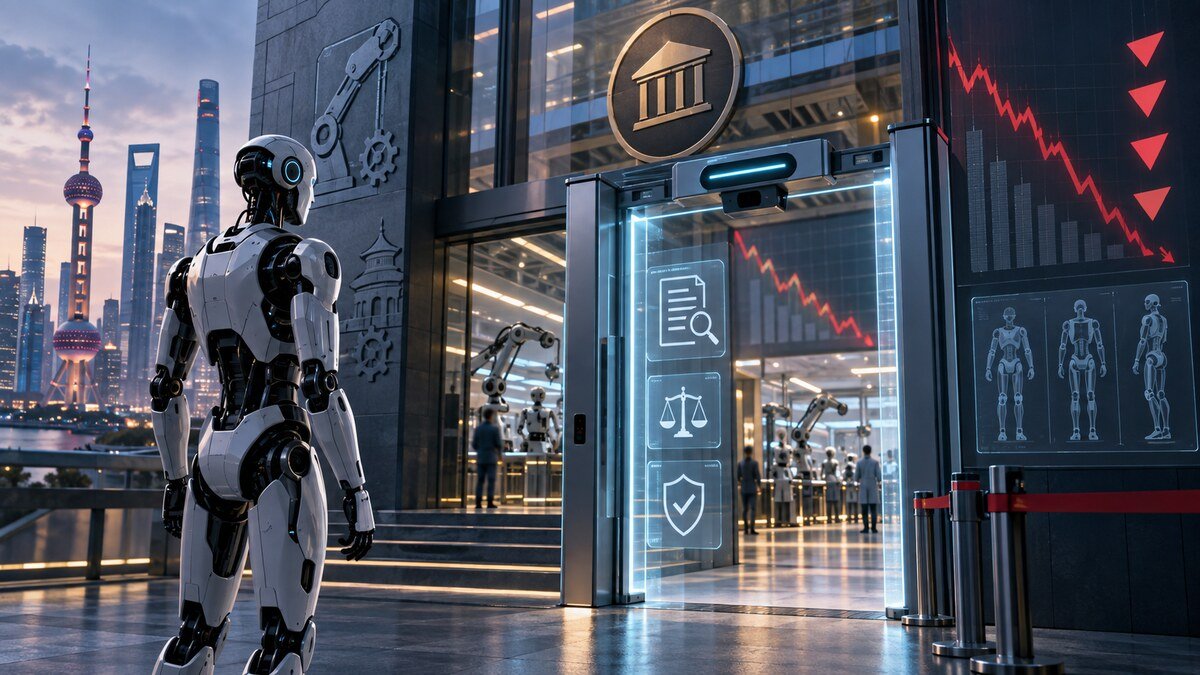
China’s humanoid robot industry has spent the past several years moving at extraordinary speed.
New companies have launched robots, factories have expanded, government-backed programs have accelerated investment and public-market enthusiasm has pushed valuations sharply higher.
Now the sector is facing a different question:
How much of the boom is supported by sustainable commercial demand?
Reuters reported on September 21 that Chinese regulators are slowing or delaying some humanoid robot IPO plans as they take a harder look at company valuations, revenue quality and the role of state-supported projects.
The shift does not mean Beijing is abandoning humanoid robotics.
China continues to treat embodied intelligence and advanced robotics as strategic technologies.
But the message to companies appears to be changing.
Impressive demonstrations and ambitious production targets may no longer be enough.
Unitree’s volatile debut changed the mood
One reason for the increased scrutiny is the extraordinary volatility surrounding Unitree Robotics.
Unitree became one of the most visible companies in the global humanoid sector after years of viral demonstrations involving quadrupeds and human-shaped robots.
Its public-market debut initially generated enormous investor enthusiasm.
But Reuters reported that the company’s shares later fell roughly 55% from their post-listing peak.
That does not by itself prove anything about Unitree’s long-term prospects.
Young technology sectors frequently experience extreme valuations and rapid corrections.
But the episode appears to have intensified concerns that public-market enthusiasm may be moving faster than the commercial maturity of the industry.
Regulators are looking more closely at revenue
The central issue is not whether humanoid robots have technological potential.
It is whether current company revenue accurately represents broad customer demand.
According to Reuters, Chinese regulators are scrutinizing the sustainability of revenue associated with state-supported projects, including robot data-collection centers and government-backed ventures.
Those programs can play an important role in developing new industries.
They provide capital, training environments and early customers while technology is still immature.
But investors need to understand the difference between revenue generated by competitive commercial demand and revenue created partly through public-sector support.
That distinction matters when valuing companies preparing to enter public markets.
Humanoid robotics is entering its proof phase
The global humanoid industry is moving from prototypes toward industrial testing.
Companies including Unitree, UBTECH, AgiBot, Figure, Agility Robotics, Boston Dynamics and others are trying to place robots in factories, warehouses and logistics environments.
The difficult part is no longer building a robot that can walk.
A commercially useful humanoid needs to perform repeatable tasks for long periods, work safely around people, recover from errors and justify its cost.
Those requirements are much harder than producing a successful demonstration.
As a result, the most important numbers in the sector may gradually shift away from speed, height and degrees of freedom.
Investors are likely to focus more on:
- paid deployments
- recurring customers
- utilization
- task success rates
- service and maintenance costs
- gross margins
- repeat orders
That would represent a healthy maturation of the market.
China still wants to lead
Greater IPO scrutiny should not be confused with a retreat from robotics policy.
China has made embodied intelligence a major industrial priority and continues to support real-world robot deployment, manufacturing capacity and data collection.
The country also benefits from one of the world’s deepest hardware supply chains.
Motors, batteries, sensors, actuators, electronics and manufacturing infrastructure can often be sourced domestically.
That gives Chinese companies an important advantage as the humanoid industry attempts to reduce costs.
What may be changing is the standard companies have to meet before public investors are asked to fund the next stage.
Hype versus commercial reality
Every major technology cycle produces a period when expectations move faster than practical deployment.
The internet had it.
Electric vehicles had it.
Generative AI has experienced it.
Humanoid robotics is unlikely to be different.
That does not mean the technology is a bubble or that its long-term potential is exaggerated.
It means investors need to separate several different questions.
Can the robot work?
Can it work reliably?
Can it work cheaply enough?
Can thousands of customers find valuable tasks for it?
Those questions are related, but they are not the same.
RoviVox View
China’s tougher scrutiny could ultimately strengthen its humanoid industry.
A sector built entirely around demonstrations, subsidies and investor excitement would be fragile.
A sector built around robots that customers repeatedly pay to deploy would be far more durable.
The most interesting part of this shift is therefore not that regulators are slowing some IPOs.
It is what companies will now have to prove.
The next phase of the humanoid race may be less about who can generate the biggest headline and more about who can generate the strongest order book from customers that still want the robots after the demonstration is over.