

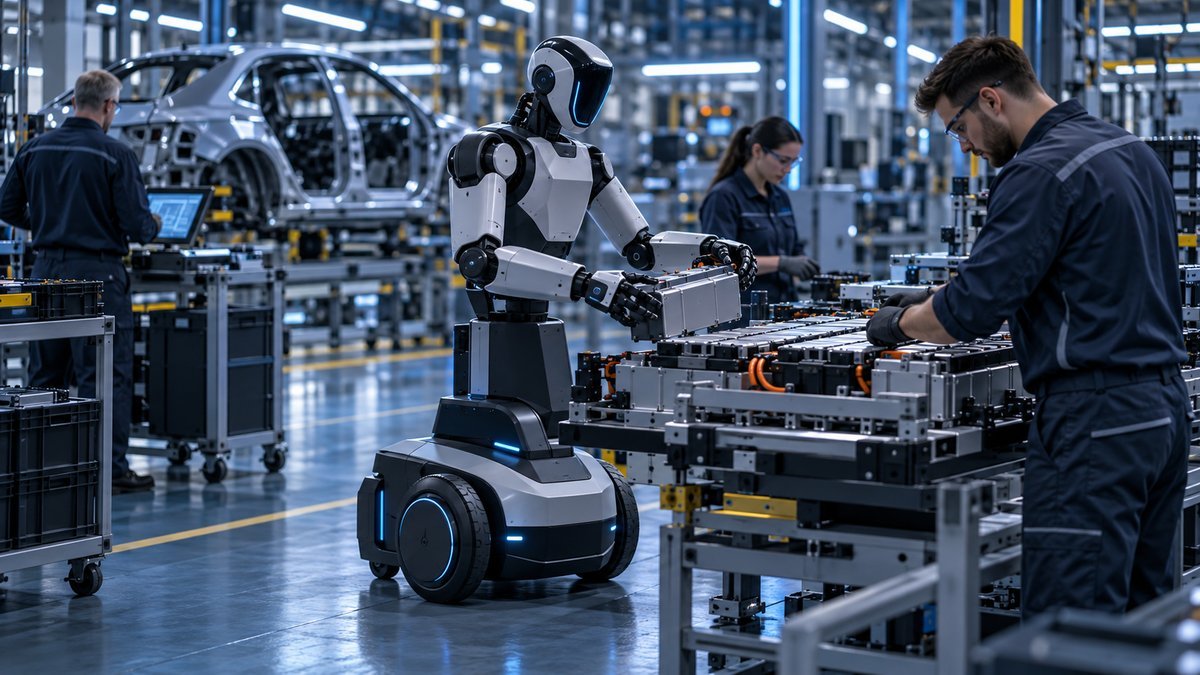
BMW is bringing humanoid robotics into production in Germany.
At the company’s Leipzig plant, a robot named AEON is being tested in manufacturing tasks involving high-voltage battery modules and component production.
BMW describes the project as its first use of humanoid robots in production in Germany.
The pilot is part of a wider push into Physical AI — systems where artificial intelligence is connected directly to machines that act in the physical world.
AEON is different from many of the humanoids attracting attention online.
Instead of walking on two human-like feet, it moves on wheels.
That design reflects a practical industrial question:
Does a factory robot need to look exactly like a person, or does it need to work effectively in environments built for people?
A wheeled humanoid enters the factory
AEON was developed by Hexagon Robotics.
BMW says the robot stands about 1.65 meters tall and weighs roughly 60 kilograms.
It can move through the factory at speeds of up to 2.5 meters per second.
Its upper body is human-like, while its lower section uses wheels rather than conventional bipedal legs.
The robot can accept different hands, grippers or scanning tools, allowing the same base platform to be adapted for multiple tasks.
That modular approach could be useful in manufacturing.
A factory may not need a different robot for every operation if one mobile platform can change tools.
Leipzig is testing real production integration
BMW says AEON will initially support work around high-voltage battery assembly and component manufacturing.
The company is using the pilot to study more than whether the robot can perform a single task.
BMW wants to understand how a human-shaped machine can be integrated into an existing production system.
That includes workstation design, material flow, safety and cooperation with employees.
The project began with theoretical evaluation and laboratory testing.
AEON first entered the Leipzig plant in December 2025.
Further testing followed during 2026, with the goal of preparing for a production pilot.
Physical AI is bigger than one robot
BMW describes Physical AI as the connection between digital artificial intelligence and machines that operate in the real world.
The robot is only one part of that architecture.
Factories also need data platforms, digital twins, AI agents, autonomous transport systems and software capable of coordinating physical processes.
BMW has created a Center of Competence for Physical AI in Production to bring those technologies together.
The center evaluates technology partners, develops pilot projects and helps move systems from the laboratory into factory environments.
That suggests BMW does not view humanoids as a standalone novelty.
They are being treated as another layer of a broader digital-production system.
The company already has experience in the United States
BMW’s humanoid program did not begin in Germany.
At its Spartanburg plant in South Carolina, BMW previously tested Figure AI’s Figure 02 robot. RoviVox has also covered BMW’s next Figure 03 logistics project.
BMW says the robot supported production associated with more than 30,000 BMW X3 vehicles during a ten-month pilot.
It moved more than 90,000 components, accumulated roughly 1,250 operating hours and completed about 1.2 million steps.
Those numbers should be interpreted correctly.
They do not mean Figure 02 built 30,000 cars by itself.
The robot performed a defined material-handling task inside a production process associated with that vehicle volume.
The distinction is important because humanoid pilot programs are often described more dramatically than their actual role.
What BMW learned from Spartanburg
The U.S. pilot produced practical lessons.
BMW says Figure 02 learned to perform repeatable positioning tasks and became integrated into the company’s Smart Robotics environment.
But the factory also needed additional safety concepts, including barriers and partitions, as well as improved 5G coverage.
Those details matter.
Deploying robots into existing factories is not simply a matter of buying a humanoid and turning it on.
Infrastructure has to change around the machine.
Leipzig gives BMW another opportunity to learn what that integration looks like with a different robot design.
Wheels versus legs
AEON also highlights an important debate in humanoid robotics.
Bipedal legs are useful when robots need to climb stairs, cross uneven terrain or move through environments where wheels cannot.
But factories generally have flat floors.
Wheels can be faster, simpler and more energy-efficient.
A robot with a human-like upper body and wheeled base may therefore be more practical for many industrial tasks than a fully bipedal machine.
The answer depends on the job.
The humanoid market may ultimately include several body designs rather than one standard human replica.
Humans remain part of the system
BMW says the objective is not simply to replace workers.
The company is focusing on repetitive, ergonomically difficult and physically demanding operations.
Employees can then concentrate on tasks involving process knowledge, judgment, quality and management of the technology.
That is BMW’s stated position.
The longer-term impact of humanoid automation on employment will depend on how widely such systems are deployed and which tasks become economically automatable.
For now, AEON remains part of a pilot program.
RoviVox View
BMW’s Leipzig project is interesting because it looks less like a robotics demonstration and more like industrial engineering.
The questions are practical.
Where should the robot work?
What tools should it use?
How does it move material?
What needs to change in the factory?
How do people work around it safely?
Those questions are less exciting than a viral humanoid video.
They are also the questions that determine whether robots eventually become normal production equipment.
AEON’s wheeled design is especially revealing.
The future of humanoid robotics may not be about copying the human body perfectly.
It may be about keeping the parts of the human form that are useful — arms, reach, tool use and mobility — while changing the parts that machines can do better.