

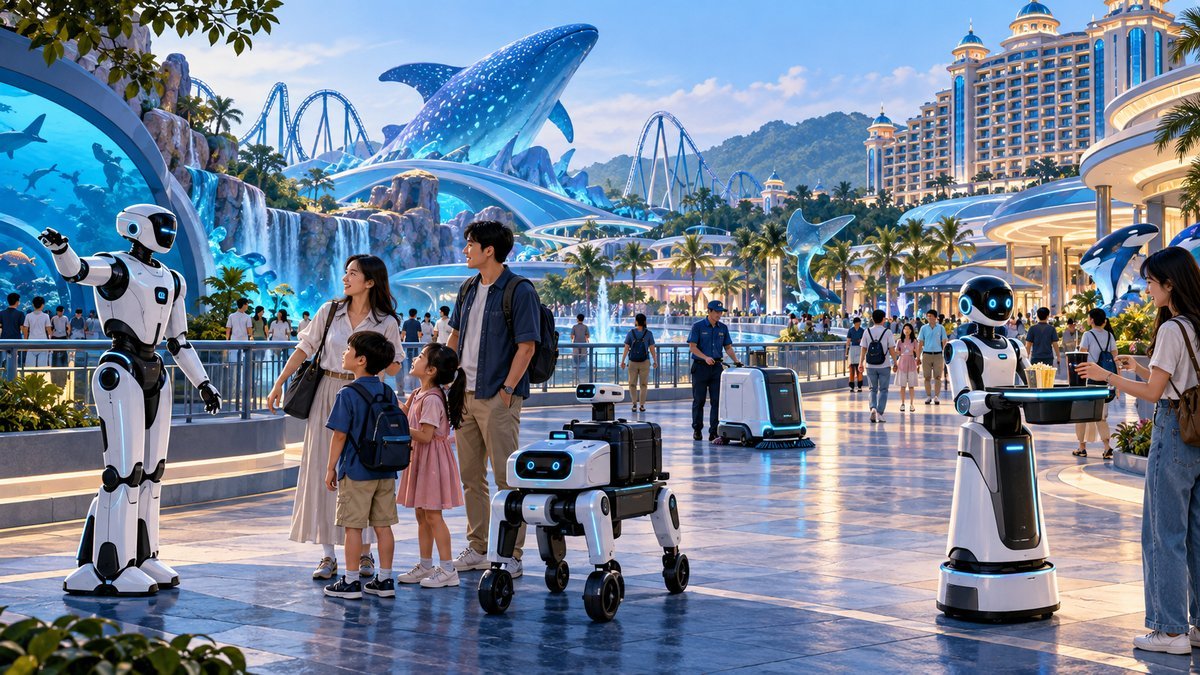
More than 300 robots are moving into a real theme-park environment in China.
That sounds like the setup for a futuristic attraction. But the more important part of the story is what those machines are being asked to do.
AGIBOT and Chimelong Group have launched the first phase of a large-scale embodied AI deployment at Chimelong Spaceship Park in Zhuhai, integrating robots into entertainment, education, visitor services and hotel operations.
The deployment includes humanoid and other service robots working across guest-facing and operational scenarios.
It is a significant real-world test of robotics at scale.
But it is not a fully autonomous, robot-run theme park.
People still operate the venue, and the robots are being integrated into selected tasks rather than replacing the entire human workforce.
That distinction matters.
Seven different roles across the visitor experience
AGIBOT says the robots are being deployed across seven core scenarios.
These include live entertainment, science education, guided tours, retail service stations, AI companion experiences, hotel services and sports competitions.
Visitors may encounter robots performing martial arts, gymnastics or tai chi.
Other robots can participate in table-tennis demonstrations, manipulation challenges or educational activities.
Some systems are being used to answer questions, introduce exhibits, provide directions and guide visitors through designated areas.
The deployment also extends into hospitality.
AGIBOT says robots can welcome hotel guests, hold multi-turn conversations and provide more personalized interactions.
That makes the project more interesting than a single robot demonstration on a stage.
The robots are being placed in multiple environments where they have to interact with ordinary visitors.
Why a theme park is a useful robotics test bed
Factories are often the first place companies test advanced robots because industrial environments are relatively controlled.
A theme park is different.
People move unpredictably.
Children approach machines from unusual directions.
Noise levels change.
Questions are not always phrased clearly.
Crowds form and disappear.
Hotels introduce another layer of variation.
That makes tourism and hospitality useful environments for testing how embodied AI performs around the public.
The challenge is not simply navigation.
A service robot has to behave safely, understand what people want and respond in ways that are useful rather than frustrating.
More than a collection of standalone robots
AGIBOT says the Chimelong deployment is supported by dedicated connectivity, multi-robot coordination and safety systems.
That detail is important.
A future filled with useful robots will not only require better individual machines.
Large deployments will also need infrastructure.
Operators have to know where robots are, what they are doing, whether batteries are charged and whether a machine needs maintenance.
Multiple robots may need to share spaces without blocking one another or creating hazards.
In other words, scaling robotics is partly a fleet-management problem.
A theme park containing hundreds of robots offers a way to test that operational layer.
AGIBOT marks another production milestone
The Chimelong launch also coincided with delivery of the 20,000th robot to roll off AGIBOT’s production line, according to the company.
The milestone links two sides of the robotics business.
One is manufacturing.
The other is deployment.
Building thousands of machines is not enough if companies cannot find useful places to put them.
Large projects such as Chimelong give AGIBOT a chance to prove that production volume can translate into real operational use.
That is becoming one of the central questions across the humanoid and embodied-AI industry. RoviVox has also examined the gap between robot manufacturing capacity and routine deployment.
Entertainment may be easier than factory productivity
Not every robot in the park needs to generate direct labor savings.
Entertainment has different economics.
A robot can create value because visitors want to see it.
A martial-arts performance or an interactive humanoid may attract attention even if a human performer could technically do the same task.
That makes tourism a useful early market for robotics.
The robot does not always have to outperform a person.
Sometimes the novelty is part of the product.
But service tasks such as guidance, hotel assistance and retail interaction will be judged differently.
Those roles require reliability.
A robot that fails during a stage performance may be amusing.
A robot that repeatedly gives guests bad directions is a business problem.
Real-world deployment is becoming the new benchmark
The robotics industry spent years showing what machines could do under controlled conditions.
Now the emphasis is shifting toward deployment.
How often does the robot work correctly?
How much human supervision does it need?
How does it behave around people?
How difficult is it to manage hundreds of machines at once?
Those questions cannot be answered completely inside a laboratory.
They require real environments.
Chimelong gives AGIBOT one of its largest public-facing environments yet.
RoviVox View
The headline number — more than 300 robots — is impressive.
But the deeper story is not that China suddenly has a robot-run theme park.
It does not.
The important development is that hundreds of embodied-AI systems are being placed into one complex commercial environment at the same time.
That creates something the robotics industry badly needs: operational experience.
Every interaction, failure, maintenance event and successful task can teach operators and developers something about what large-scale robot deployment actually requires.
The next stage of robotics will not be decided only by which company builds the most impressive machine.
It will also be decided by which companies learn how to operate hundreds or thousands of robots reliably in the real world.