

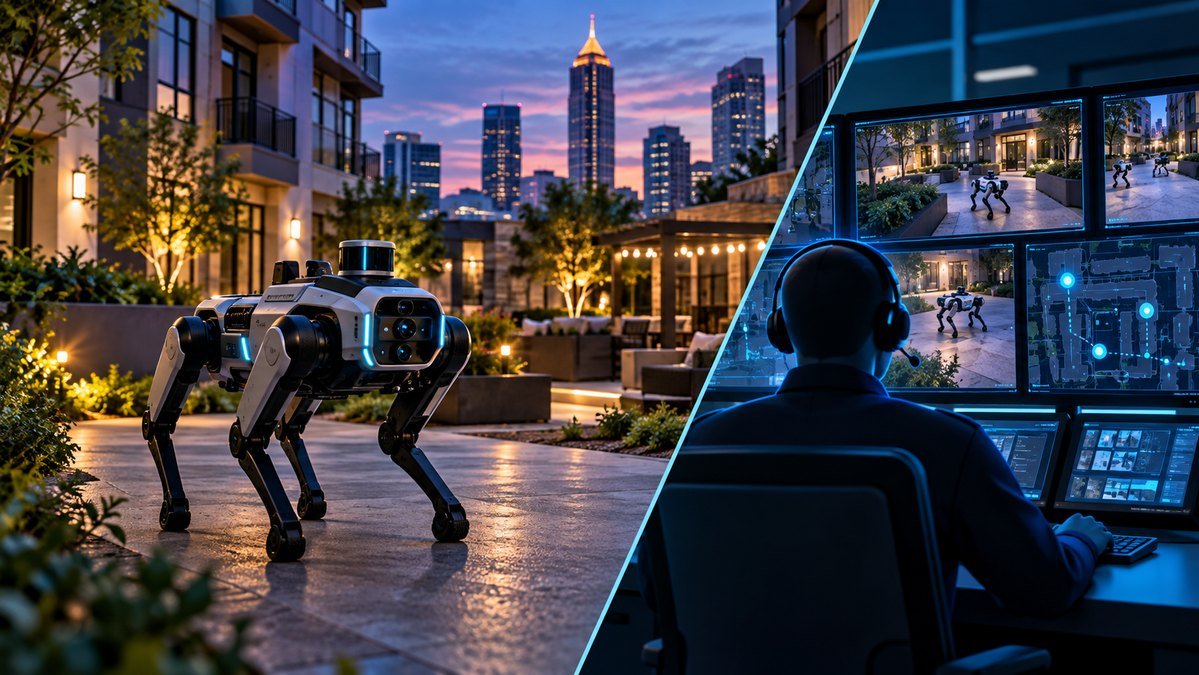
At an Atlanta apartment complex, an overnight security patrol can now arrive on four mechanical legs. The machine has cameras and a speaker, but it is not deciding on its own whom to confront. A person watching from elsewhere directs the robot and can speak through it.
That distinction is central to the story of robot dogs at 445 Cleveland. According to Reuters reporting published in August, the property had previously used roughly two or three guards for nights and weekends. It has since switched to robotic patrols operated through a remote security service.
The change raises a real question about on-site guard work. It also shows why saying that robots simply replaced humans gives an incomplete picture: the human role has moved from walking the grounds to monitoring and responding from a distance.
What changed at 445 Cleveland
A robot dog can move through the property carrying cameras, sensors and a speaker. When an operator notices something that needs checking, the robot provides a way to look closer and make its presence felt in the courtyard or parking area. The operator can address a person through the speaker and contact police if the situation calls for it.
The machine is a mobile point of view and a remote voice. It is not an independent security officer. Carlos Cabello, a manager at 445 Cleveland, told Reuters that someone behind a screen manages and controls the robots. His description of the system was emphatic: there is a human on the other end.
That makes this a form of teleoperation. A human operator uses a remote robot to extend the reach of cameras and communication into the physical space. Software can assist with monitoring, but the publicly described patrol should not be presented as a fully autonomous AI guard making its own enforcement decisions.
A May vehicle break-in response
A separate Atlanta apartment complex offered a more concrete example of the workflow in May 2026. Atlanta News First reported that security cameras showed suspects connected to vehicle break-ins at Columbia Crest Apartments. A robot dog moved in the area while the security team notified police.
WSB-TV reported that responding officers spoke with the robot operator and made an arrest. The robot did not arrest anyone. The practical contribution was remote observation, communication and a presence on the ground while people coordinated the response.
That incident is evidence that the system can be useful in a specific response. It does not establish that a robot can prevent every crime or replace every duty performed by a trained guard.
What the crime figures actually show
Undaunted, the company behind the service, has reported sharp declines at properties using its system: 100% fewer residential burglaries, 75% fewer vehicle thefts and 65% fewer vehicle break-ins. Those are company figures presented to Reuters, not independently verified findings. They should be read as claims by the operator, not a measured result that can automatically be applied to other properties.
To evaluate the effect rigorously, a reader would need the starting number of incidents, the period measured, the properties included and information about other changes in staffing or policing. A 100% reduction can have very different meaning depending on whether the baseline was one burglary or many. The published numbers alone cannot isolate the robots as the cause.
Residents may still care about whether the patrol makes them feel safer. But the value of a security service includes more than a percentage change: how quickly someone notices a problem, who decides what to do and how the system handles false alarms and privacy all matter.
Guard work moves to another location
Remote operation can alter a security budget and the type of work it buys. One person may be able to monitor cameras and direct a mobile robot from a control room rather than remain physically on site throughout a shift. That may reduce demand for some traditional patrol posts, while creating or expanding roles in remote monitoring, maintenance and incident coordination.
Those roles are not necessarily equivalent in pay, staffing levels or working conditions. Nor can a mobile robot perform every task a human guard can, including physical assistance, nuanced de-escalation and immediate intervention. Property owners still have to decide which situations require a person at the site.
The difference between a remotely operated platform and an autonomous machine matters across robotics. RoviVox has also examined why clear descriptions of robot capabilities matter as more systems enter workplaces and public spaces.
RoviVox View
The Atlanta deployments are a useful example of automation changing the shape of a job before eliminating the human decision-maker. The patrol may have four legs, but the eyes interpreting its video and the voice coming from its speaker belong to people.
For the business case, the next question is whether remote teams can deliver reliable, accountable service across many properties without losing the local knowledge and immediate help residents expect from on-site staff.
For the public, the test should be transparent reporting: what the robots actually do, what operators do, how incidents are recorded and whether independent evidence supports the claimed safety gains. A striking demonstration is easy to film. Trustworthy long-term security is harder to prove.