

For a few hours in Warsaw this week, a scene that looked like science fiction became a real-world political demonstration.
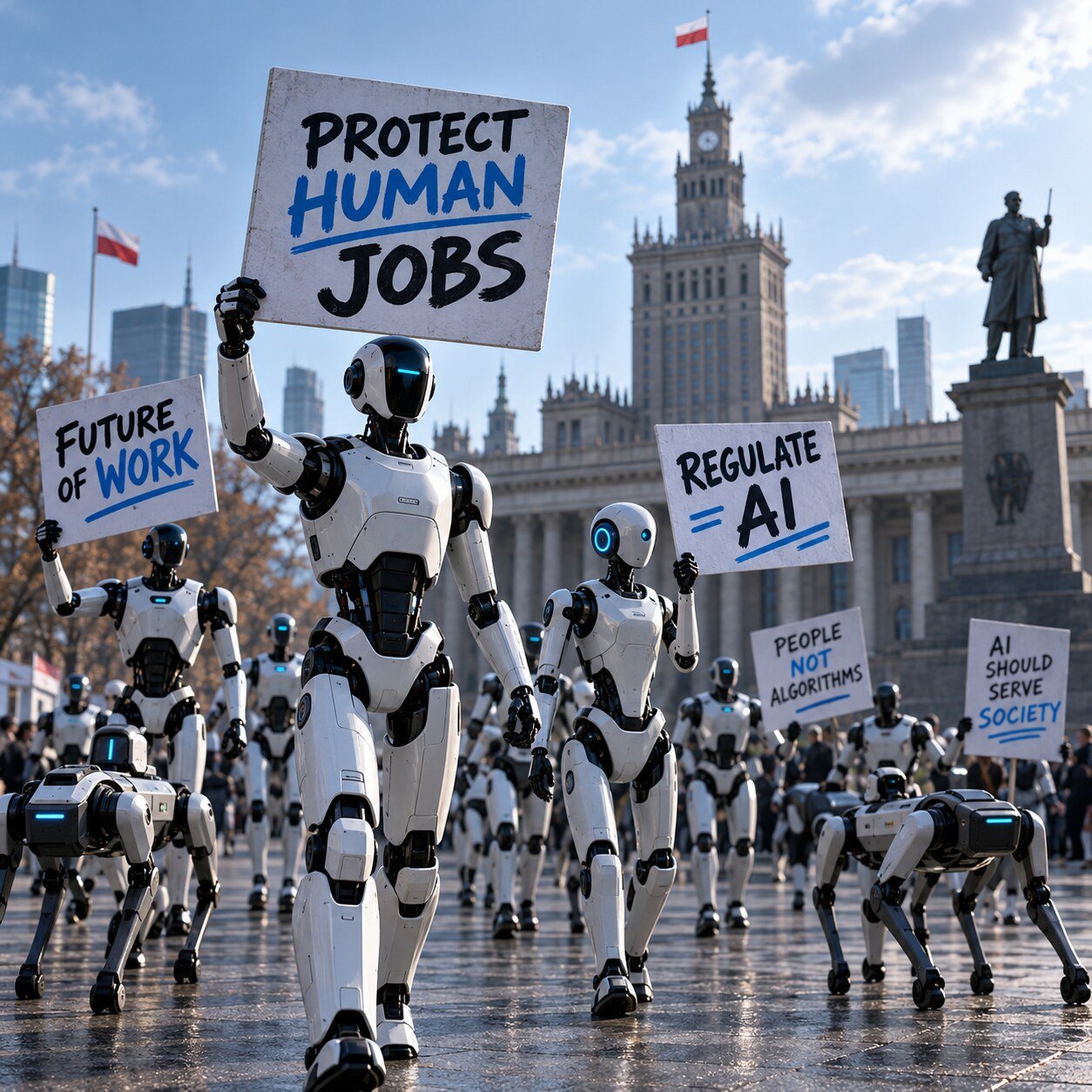
Around 30 robots — including humanoid machines and four-legged robotic systems — gathered outside Poland’s Ministry of Digital Affairs on September 7.
But the robots had not suddenly developed political opinions.
The protest was deliberately staged by people.
And that distinction is what makes the story more interesting.
The machines were being used to deliver a message about something that increasingly concerns workers around the world: what happens to human jobs as artificial intelligence and robotics become more capable?
Robots protesting against the technology they represent
The demonstration was organised by an initiative called Democratism, which says it wants to encourage public debate about how artificial intelligence and robotisation could affect the labour market.
Recorded slogans calling for workplace protection and AI regulation were played during the demonstration while the robots moved outside the ministry.
The machines ranged from two-legged humanoids to dog-like quadruped robots.
One humanoid, an Agibot A3, even interacted with journalists during the event.
The visual contradiction was intentional.
Machines that represent the future of automation were being used to warn society about the potential consequences of automation.
Organisers said their concern was not limited to factory workers.
Modern artificial intelligence can increasingly perform cognitive tasks as well, potentially affecting office jobs, customer service, administration, creative work and other areas that historically seemed less exposed to automation.
This was not a robot uprising
Some headlines surrounding the event made it sound as if robots themselves had taken to the streets demanding rights.
That is not what happened.
The demonstration was organised and controlled by humans.
The slogans were part of the event, and the robots were being used as communication tools.
There is no evidence that the machines independently organised the protest or autonomously decided to campaign against artificial intelligence.
This matters because robotics reporting can easily cross the line from interesting to misleading.
Humanoid robots are advancing quickly, but demonstrations should not be confused with human-like independence or political agency.
The real story in Warsaw was not that robots had learned to protest.
It was that people believed robots were powerful enough symbols of technological change to make a labour-policy argument impossible to ignore.
Poland’s digital minister joined the discussion
The unusual spectacle attracted the attention of Poland’s Digital Affairs Minister Krzysztof Gawkowski.
He came out to meet the organisers and discuss the concerns raised by the demonstration.
The event therefore moved beyond being purely a technology spectacle.
It became a public conversation involving government, automation and employment.
That conversation is becoming increasingly relevant across Europe.
AI systems are improving rapidly while robotics companies are investing heavily in machines designed to work in factories, warehouses, logistics operations and eventually less structured environments.
None of this means millions of humanoids are about to replace human workers overnight.
Today’s robots continue to face significant limitations involving reliability, dexterity, battery life, safety, cost and the ability to adapt to unexpected situations.
But technology does not have to replace every worker to change a labour market.
Automation can change the number of people required for a task, alter the skills employers need or shift certain jobs toward monitoring and managing machines.
The protest was also a technology demonstration
There was another layer to the Warsaw event.
According to Polish reporting, the Democratism initiative is linked to Delta Robots, a company involved with robots used for events.
That makes it reasonable to view the demonstration as both a policy message and a highly effective public showcase of modern robotics.
Those two things are not necessarily contradictory.
The robots attracted cameras precisely because seeing humanoids and quadrupeds carrying protest signs creates an image that people immediately understand.
A traditional conference about automation policy would probably have received far less attention.
Thirty robots standing outside a government ministry created a story that travelled internationally within hours.
Europe faces a larger question
The important issue raised by Warsaw is not whether robots deserve workers’ rights.
It is how societies should manage the transition when increasingly capable machines begin performing more tasks currently done by people.
Some jobs will change.
Some may disappear.
Others will be created.
And many workers may need new skills.
The difficult policy questions involve timing.
Should governments wait until displacement becomes significant before responding?
Who pays for retraining?
How should productivity gains from automation be distributed?
What responsibilities should companies have when introducing AI systems that substantially change their workforce?
And how can governments regulate emerging technologies without slowing useful innovation?
These questions do not have simple answers.
But they are becoming harder to dismiss.
Humanoid robots make automation feel different
Industrial automation has existed for decades.
A robotic arm behind a factory safety fence rarely creates the same emotional reaction as a machine with two arms, two legs and a head walking through a human environment.
Humanoid robots make automation visible in a fundamentally different way.
That may partly explain why the Warsaw protest attracted so much attention.
A humanoid occupies physical spaces designed for people.
It can potentially use tools, open doors, move carts and work at stations originally created for human workers.
That does not mean humanoids are currently capable of replacing people across the economy.
They are not.
But their form makes the long-term possibility easier for the public to imagine.
And once people can imagine that future, questions about employment and regulation become much more immediate.
RoviVox View
The Warsaw demonstration succeeded because it contained a powerful contradiction.
Robots were used to warn humans about robots.
Behind the spectacle is a serious issue.
The robotics industry is entering a stage where the central question is moving away from whether humanoid machines can walk, dance or perform controlled demonstrations.
The more important question is whether they can perform economically useful work.
If they can, the discussion about robotics will increasingly move outside technology laboratories and into factories, boardrooms, parliaments and labour negotiations.
Governments should avoid treating every new robot demonstration as evidence of imminent mass unemployment.
The technology is not there yet.
But ignoring the potential labour impact until large-scale displacement has already occurred would be equally shortsighted.
Warsaw’s robot protest was staged.
The debate behind it is real.