

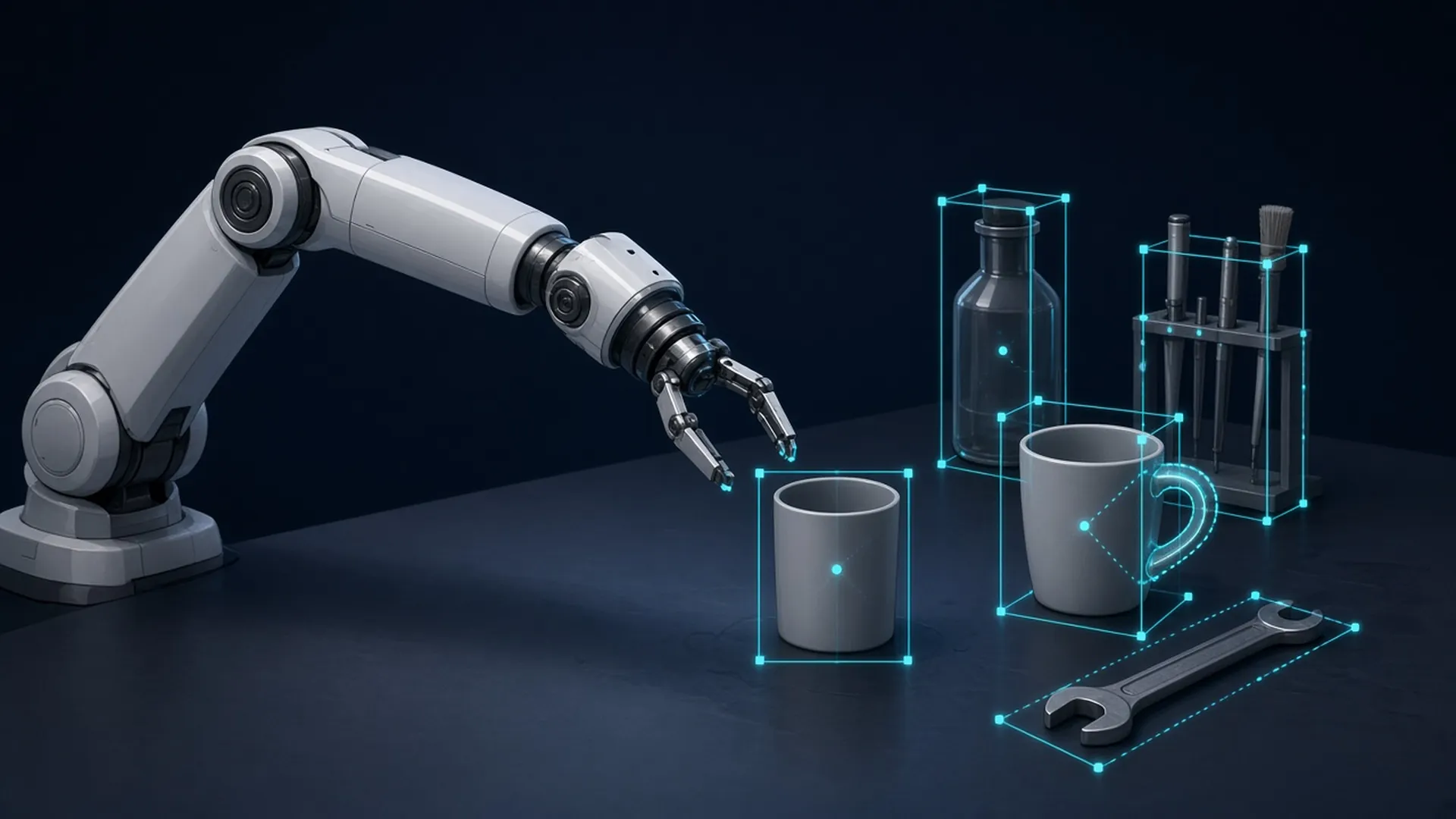
Robots don’t just need to think. They need to see exactly where things are. A new open-source model backed by Chinese EV and robotics company XPENG targets that problem directly.
GroundingPI is a visual perception model of about 4 billion parameters, developed by researchers affiliated with XPENG, Peking University, the University of Hong Kong and other institutions, XPENG announced on November 4. The paper, model weights and code are public on GitHub and Hugging Face.
Finding “the handle of the cup on the right”
Instead of training on robot actions, GroundingPI focuses on the basics: identifying objects and pinpointing where they are, using points and bounding boxes. XPENG’s example is an instruction like “the handle of the cup on the right,” where a robot must find the right cup and then the exact spot on it.
The model is trained across 11 categories of perception skills, including object detection, dense object localisation, text recognition, document layout, user-interface elements and robot spatial localisation.
The benchmark claims
In the research team’s own evaluation, GroundingPI scored an average of 73.68 across 34 public perception benchmarks, the highest of 44 baseline models, ahead of GPT-6 Astra at 71.54. XPENG notes this covers perception tasks only, not general intelligence or reasoning. These are the team’s results and have not yet been independently replicated.
In simulation, robot-learning systems using GroundingPI as their “eyes” reportedly reached higher success rates with 50% of the demonstration data than comparison models given 75%, and handled unfamiliar environments better in RoboTwin 2.0 tests.