

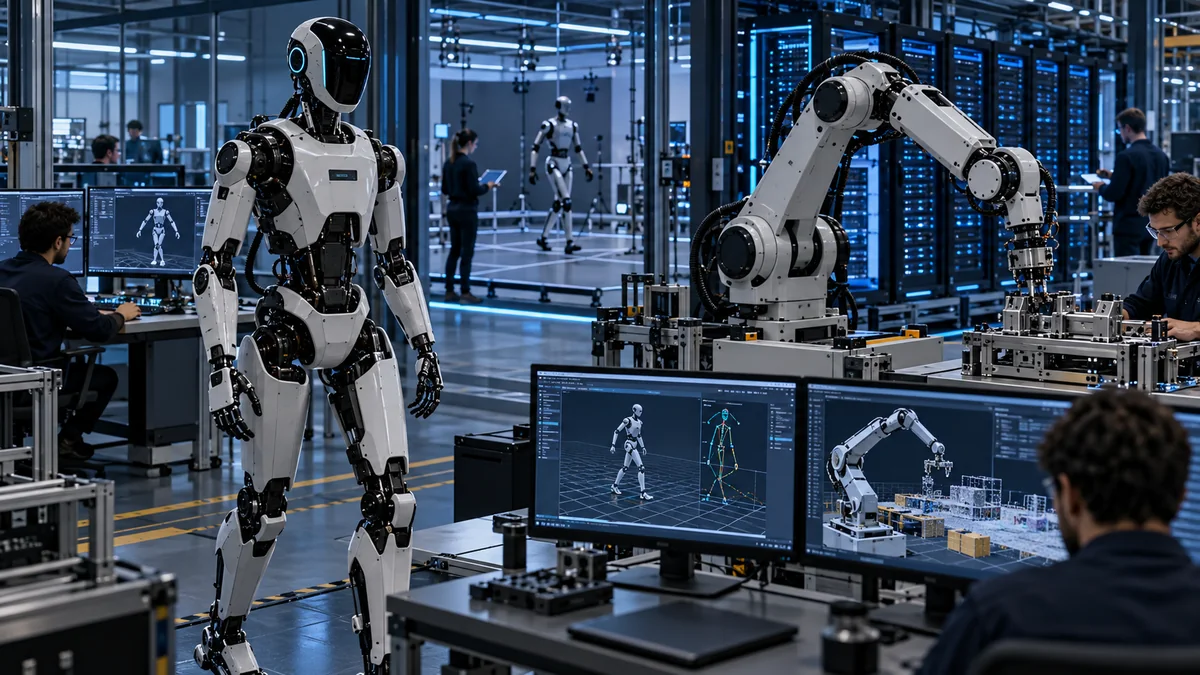
NVIDIA wants to provide the robotics stack
NVIDIA’s latest robotics announcement is not centered on selling a single robot. It is about supplying more of the technology that other companies need to build one.
At GTC Berlin on October 21, the company expanded its Isaac platform across robot models, runtime software, simulation, datasets and development workflows. The aim is to make physical AI easier to train, test and deploy across different machines.
That is a larger ambition than attaching AI software to a humanoid. NVIDIA wants its tools to become part of the development process from simulated training to operation on a real robot.
A reference humanoid changes the strategy
Agile Robots announced Agile ONE SN as a humanoid reference platform built on NVIDIA Isaac GR00T and Jetson Thor. The companies also describe planned integration with NVIDIA’s Halos safety stack.
A reference platform gives developers a common starting point for experimenting with models, sensors, compute and robot behavior. It does not mean Agile ONE SN is already a widely deployed finished product. Likewise, planned safety integration should not be described as a completed certification.
The value is in making the connections between hardware and software more explicit, so researchers and manufacturers can test a system rather than assemble every part from scratch.
Europe is becoming a Physical AI laboratory
NVIDIA named a range of European robotics companies in its ecosystem, including ABB Robotics, Flexion, Hexagon Robotics, Humanoid, KUKA, NEURA Robotics, Sereact and Universal Robots.
Their products and approaches differ, but together they show why Europe matters: the region combines industrial automation expertise, robot makers, manufacturing customers and research groups. NVIDIA is trying to make its tools useful across that diversity.
RoviVox has covered BMW’s AEON pilot in Leipzig, another example of the practical integration questions European factory projects must answer. A platform announcement and a factory pilot are different stages, but both point toward software and hardware being evaluated together.
Simulation and synthetic data may be as important as hardware
NVIDIA introduced Isaac OS runtime, updates to Isaac Lab 3.0 and open-source reference workflows for robot-data generation, training and evaluation.
Robots need experience with varied objects, environments and failures. Collecting every possible physical example is slow and expensive. Simulation and generated data can accelerate development, although real-world testing remains necessary to show that trained behaviors transfer reliably.
This is why a robotics stack includes more than a processor and a model. The tools used to create training data and assess performance can shape what a robot learns and how safely it is introduced into workplaces.
The robotics industry may begin to resemble the AI industry
AI developers often build on shared compute platforms, software libraries and model ecosystems. Robotics could develop a similar structure, with many hardware manufacturers relying on common training and runtime tools.
That could reduce duplicated work and speed experimentation. It might also allow a smaller robot maker to try advanced perception or manipulation systems without building a complete software infrastructure alone.
The comparison has limits. Physical machines still need task-specific engineering, safety testing and maintenance. Software reuse does not make every robot interchangeable.
The risk of one stack becoming dominant
A common platform can accelerate progress, but it can also concentrate influence over tools, interfaces and computing choices. Robot makers will weigh convenience against the costs of dependence on any single supplier.
That is an industry question rather than a verdict on this announcement. Open tools and interoperability will matter if manufacturers want to move between models, hardware and deployment environments over time.
RoviVox View
The GTC Berlin news is significant because NVIDIA is connecting the pieces of robot development: compute, models, runtime, simulation, data and a reference humanoid.
Europe provides a demanding test ground, with established automation firms and newer humanoid developers working toward real industrial use. The measure of success will be whether these tools help robots perform reliable tasks outside demonstrations.
The robotics race may increasingly be a competition between ecosystems, not merely a contest between individual robot designs.