

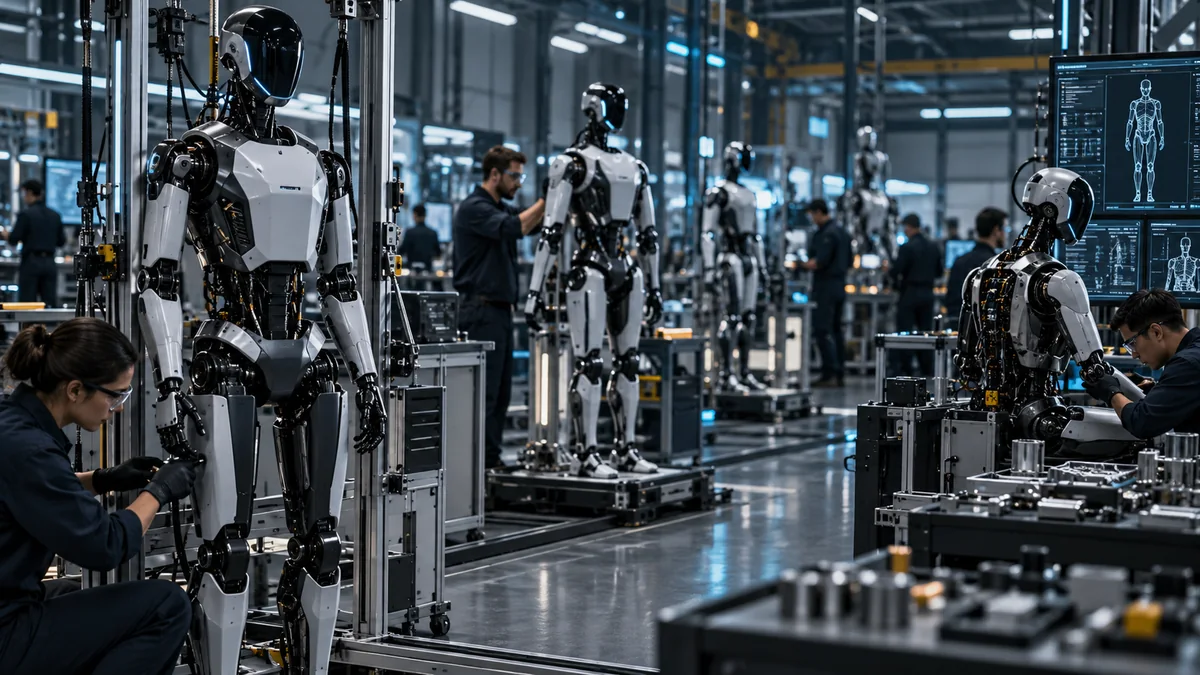
From prototype to production-quality robot
Tesla has spent years showing what Optimus might eventually do. Its latest update is about something less photogenic and potentially more consequential: how the robot is made.
In its third-quarter 2026 update, released October 21, Tesla said Optimus production has begun on high-volume lines in Fremont, California. The company calls the units coming off the line its first production-quality Optimus robots.
That is a manufacturing milestone, according to Tesla, rather than proof that humanoids are already being deployed at scale. It moves the discussion from individual prototypes toward a repeatable production process.
Fremont is now in early ramp
Tesla lists the California Optimus program as “Early Ramp.” The phrase signals that production has started, but it does not disclose how many robots are being completed each week or how quickly output will grow.
Tesla also says it has proved that the current manufacturing process can support a commercial product, while warning that both hardware and manufacturing will continue to change. A production-quality unit is therefore a step toward a sellable system, not necessarily the final design.
The distinction matters because installed capacity and actual production rate are different numbers. A line designed for high volume does not establish that high volume has already been achieved.
Why humanoid manufacturing is harder than a demo
A demonstration can be prepared around one robot, one environment and a dedicated support team. Manufacturing requires a design that can be assembled repeatedly, checked consistently and repaired when parts fail.
Humanoid robots combine motors, actuators, batteries, sensors, computers and dexterous mechanisms in a body that must repeatedly move and manipulate objects. Small variations in parts or assembly can affect reliability.
The supply chain becomes as important as the robot’s movements. RoviVox has previously examined the uncertainty around reports of new Optimus supplier audits in China. Tesla’s new statement about Fremont is firmer evidence of its own production progress, but it does not settle every question about component sourcing or eventual cost.
Commercial product does not mean mass deployment yet
Tesla has not said in this update that Optimus is already mass-produced or broadly operating at customer sites. It has described the first production-quality units and an early manufacturing ramp.
The next tests will be whether the robots can complete useful tasks reliably, how much supervision they require, how safely they work around people and what they cost to build and maintain. Those are commercial questions that a production line alone cannot answer.
Other manufacturers face similar gaps between announcements and deployment. Agility Robotics’ Digit 5 illustrates how safety and operational uptime become central once a humanoid is designed for real workplaces.
Tesla is building a second manufacturing base in Texas
Tesla’s Q3 update lists its Texas Optimus program as “Construction.” That points to another manufacturing base in development, not a second line already producing robots.
Fremont’s early ramp and the Texas buildout show Tesla preparing for a larger industrial program. Neither label provides an independently verified current output figure.
The humanoid race is becoming a manufacturing race
Robotics companies have competed for attention with faster walking, better hands and more capable AI. The competition increasingly includes quality control, component supply, serviceability and production yield.
Moving from prototypes to repeatable manufacturing is one way to make robot deployments economically plausible. It is also a stage at which engineering weaknesses become harder to hide: a system that works once must work again and again.
RoviVox View
Tesla’s statement is significant because it describes production-quality Optimus units from a manufacturing line, not merely another staged capability demonstration.
The company has crossed an important threshold in its own program. It still has to show the rate, reliability and useful work that would turn an early ramp into a large commercial fleet.
For now, the accurate conclusion is straightforward: Optimus production has begun at Fremont, according to Tesla. Mass deployment remains a future question.